

 Serra de Tramuntana
  T4
T4






Raco de Ses Barreres car park (5 m) - Ermita de la Victòria (140 m) - Penya Roja, also known as Penya del Migdia (360 m) - Talaia D'Alcudia (444 m) - Platja des Coll Baix (0 m) – Raco de Ses Barreres car park (5 m)
A technically demanding hike requiring sure-footedness and a head for heights. The rocks at the climbing sections are very smooth due to frequent use. In 2015, ropes were in place at the most difficult sections. If you want to play it safe, take a 4-metre rope with you. Individual bolts are in place at the critical points. If it becomes too difficult and there are no climbing aids available, you are probably on the wrong route. In that case, look out for cairns or red markings to find an alternative to the chosen route. Pay close attention to the weather! After rainy days, it is not possible to walk through the gorge.
From Palma, take the MA-13 to Inca, leave the motorway there and continue on the MA-2130 towards Lluc Monastery in the Serra Tramuntana. After the petrol station at Coll de Sa Bataia, keep slightly to the left onto the MA-10 and follow the road for about 4.5 kilometres. On the right-hand side of the road, just past the Escorca restaurant (named after the village of the same name), there is a small car park. The large car park belongs to the restaurant, is closed off in the morning and should not be used without consulting the owner. After a successful hike, you can take bus 355 from Cala de Sa Calobra back to Escorda (as of 2015, once daily, departing from Cala de Sa Calobra at 15:00, timetable information).
39.85003866, 2.79986361
Anzeige
It has long been known that the Balearic island of Mallorca, with the Serra Tramuntana, also has plenty to offer mountaineers. In addition to the well-known hiking peaks, such as Puig de Massanella or Puig Tomir, the gorges also lure ambitious amateur adventurers away from the pool bar into a unique environment. A particular highlight is the descent from Escorca through the Torrent de Pareis to Sa Calobra. Anyone with sure-footedness, good footwear and an eye for the cairn markings should by no means miss this tour.
We start our tour just behind the small car park, on the opposite side of the road from the Escorca restaurant. An information board shows the route through the gorge. A few metres below the car park, we pass through a small gate and walk round to the right, along the eastern side of a meadow criss-crossed by walls. From a ledge behind it, we catch our first glimpse of the imposing gorge. We are still several hundred metres above sea level from the entrance to the Torrent de Pareis, but with every hairpin bend we descend the mountain, we get closer to the entrance. To the north, the Puig Roig (1003 m) is clearly visible. We can also make out the cave house Es Cosconar and, further to the left, the Quarter de Carrabiners. After about an hour, we reach the gorge, which is still called Torrent de Lluc here.
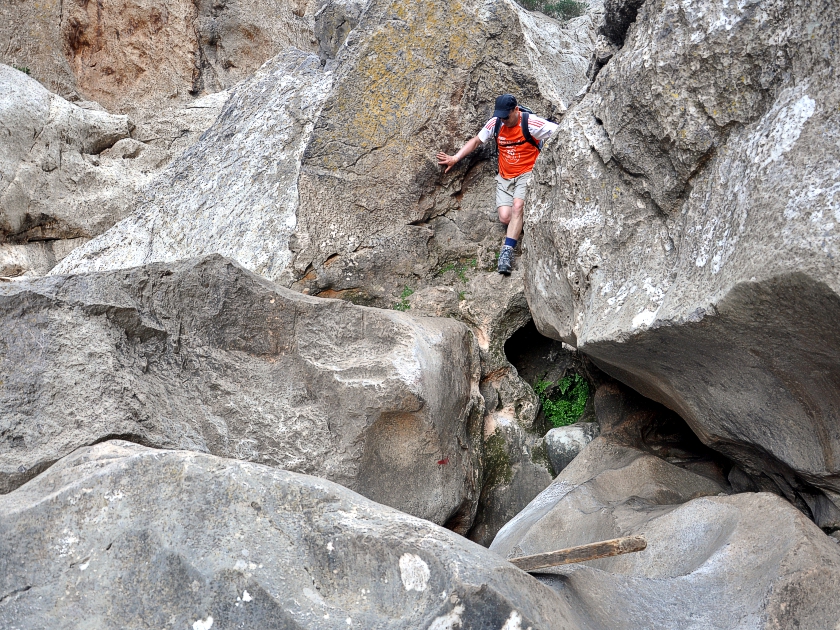 In the dry riverbed, we keep to the left and rush enthusiastically westwards. Perhaps a little too enthusiastically, as even before the junction with the Torrent de Gorg Blau we have to climb down a rather slippery step. To our left, above us, we can hear voices from another group, who seem to be bypassing the spot quite comfortably via a path. It quickly becomes clear that it’s worth keeping a constant eye out for cairns or markings, so as not to have to turn back at insurmountable obstacles. Nevertheless, we soon reach S’Entreforc, where the Torrent de Gorg Blau and the Torrent de Lluc merge to form the actual Torrent de Pareis. Those who wish to can ascend about 300 metres to the left into the increasingly dark Torrent de Gorg Blau, before it becomes increasingly difficult to continue without equipment.
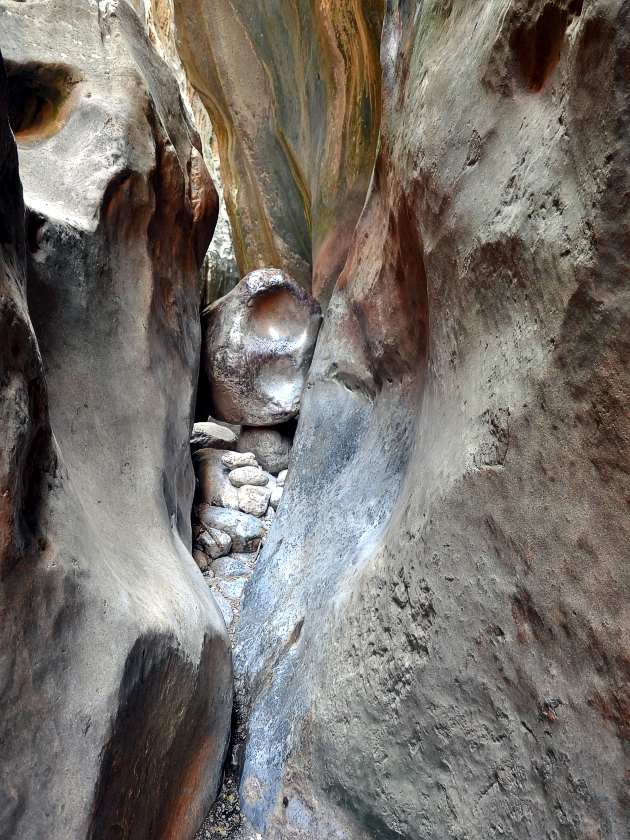
The rest of the route through the Torrent de Pareis remains challenging, even if we are spared the most difficult sections for the time being. High above us in the rock, on the eastern side of the gorge, we can make out the Cova des Soldat Pelut cave, before we have to tackle a few more climbing sections. Steps carved into the rock or small rope loops make the descent easier. Nevertheless, the path demands our full attention. We are rewarded for our efforts by the sight of unique rock formations. The water-filled pools are home to numerous tadpoles.
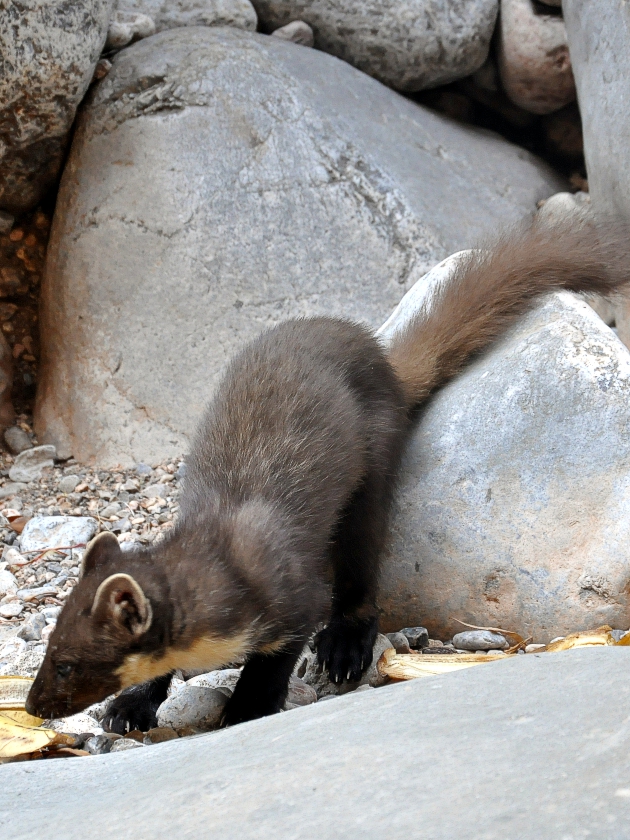
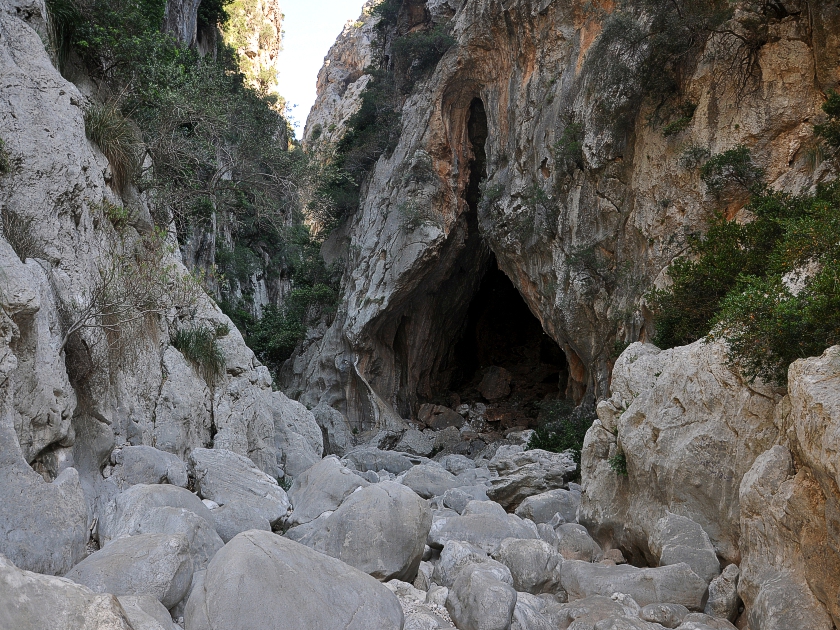 Over time, the path becomes easier again. At times we walk on a bed of gravel, which gives little hint that another steep step lies ahead just around the next bend. We bypass a particularly large step in front of the Cova des Romagueral cave on the left-hand side (cairn!). Alongside several goats scrambling around the rocks, we also spot two weasels paying us a visit whilst we take a snack break. The path is easy at first, even beyond the cave. It is only about 15 minutes later that we come across a more difficult section, where the marble, polished as smooth as in St Peter’s Basilica, gives us particular trouble.
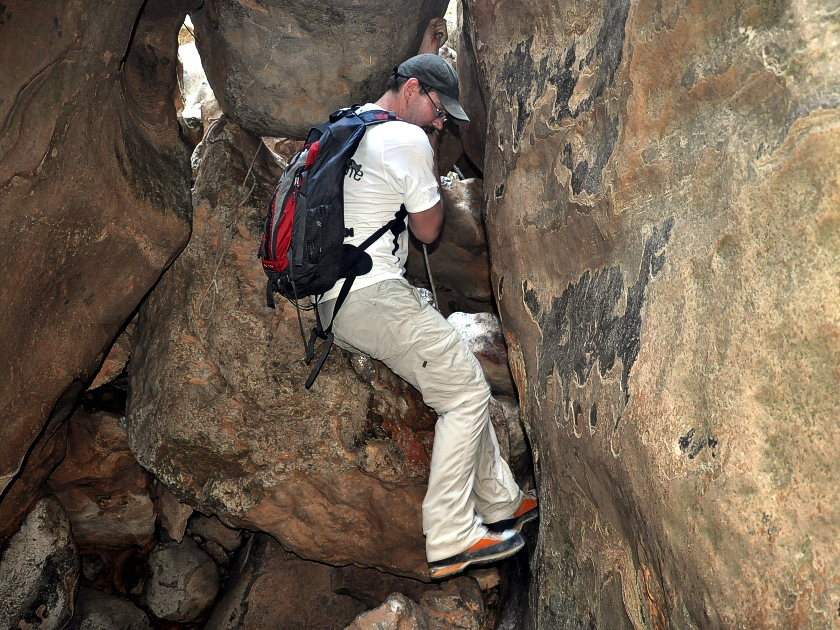 After another gravel bed, we come across a huge boulder, which this time we climb under on the left through a small hole. Thankfully, someone has attached a small rope here, which makes the descent much easier. A little later comes the final major obstacle, a spherical stone, which we leave behind by sliding on our stomachs – not very gracefully, but pragmatically. Even though there are no more technical challenges to tempt us, the gorge, which is quite narrow in places, remains impressive. We pass a striking rock pinnacle and several large pools, all of which can be bypassed.
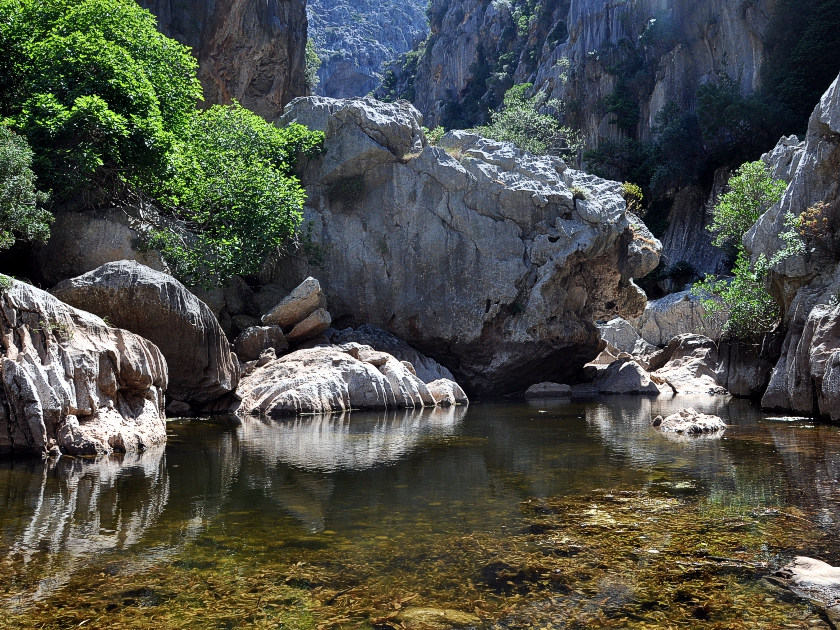 We can go round a large rock on the right, behind which a small, pretty pond has formed. Beyond it, the gorge widens considerably and the number of visitors increases sharply, suggesting that we are not far from where the gorge meets the sea. Indeed, this is quickly reached via wide gravel areas. Right at the access point to the sea, it gets a bit narrower again. Numerous bathers are milling about in a space of just 30 metres. Naturally, we join them and refresh ourselves with a hearty plunge into the turquoise-blue water.
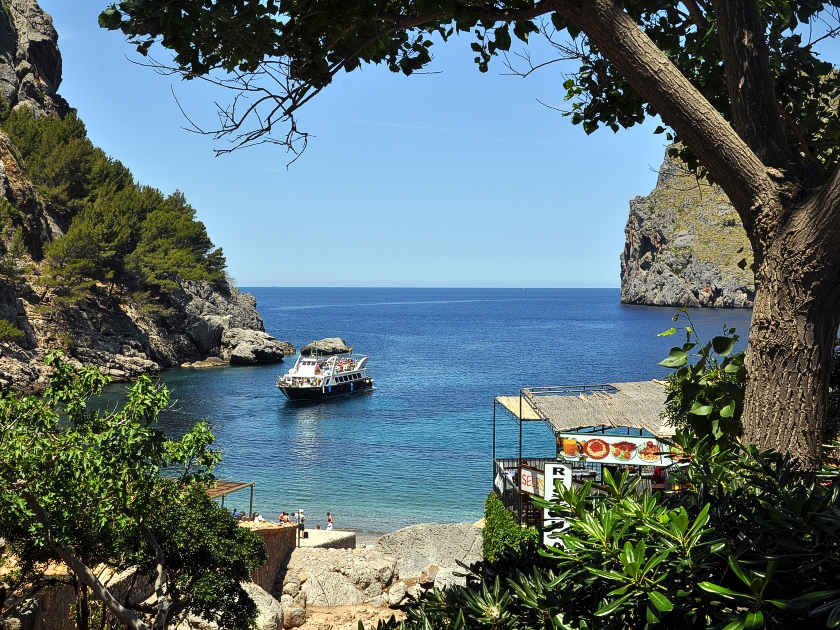 Afterwards, we walk westwards through a small tunnel to a coastal promenade, from where we once again have a magnificent view of the bay at Sa Calobra. We pass the time in one of the many small restaurants before the bus takes us back to our starting point punctually at 3 pm. Alternatively, you could take the ferry to Port de Soller. There is also a bus service from there via Escorca to Lluc (timetable information).
There are no places to stop for refreshments along the way.
| Elevation | Time | Total | Destination | ||
|---|---|---|---|---|---|
 | 650 m | - 220 m | + 1:00 | 1:00 | Einstieg in die Schlucht |
| 220 m | - 180 m | + 0:20 | 1:20 | Abzweig zum Torrent de Gorg Blau |
| 180 m | - 0 m | + 3:00 | 4:20 | Ausgang der Schlucht zum Meer |
 | 0 m | - 30 m | + 00:10 | 4:30 | Bushaltestelle Sa Calobra |